


Nobody starts a business because they love paying taxes. And yet, every year, thousands of small business owners hand over more money to the IRS than they legally have to, not out of generosity, but simply because they didn’t know about a credit that was sitting right there, waiting to be claimed.
I’m talking about the Small Business R&D Tax Credit, a federal incentive that rewards businesses for doing something they’re probably already doing: Solving hard problems, building new things, and figuring out how to make their products or processes better than they were before.
It’s not a niche benefit for tech giants. It’s not buried behind some impossible eligibility walls. It’s a real, accessible, and often surprisingly large credit for businesses of all sizes, including yours.
Let’s break it all the way down.
The R&D tax credit formally Section 41 of the Internal Revenue Code, is a federal tax incentive that rewards companies for investing in research and development. It was originally created in 1981 and made permanent in 2015. At its core, it gives you a credit against your tax liability for qualified research expenses (QREs) incurred during the year.
For small businesses specifically, there’s an additional layer of value: the Payroll Tax Offset, which allows qualifying companies to apply up to $500,000 per year of their R&D credit directly against payroll taxes even if they have zero income tax liability. More on that in a moment.
The credit is dollar-for-dollar. It’s not a deduction that reduces taxable income. An actual credit that reduces your tax bill.

This is where most people are surprised. The R&D tax credit is not limited to pharmaceutical labs or aerospace companies. Any U.S. business, regardless of size can qualify if it meets the four-part test for qualified research activities.
You need to be:
There’s no minimum revenue threshold to claim the credit. For the payroll tax offset specifically, you need gross receipts under $5 million and fewer than five years of revenue history but for the standard income tax credit, virtually any business can qualify.
The honest answer: more than you’d expect.
Industry | Common Qualifying Activities |
Software & Technology | New application development, algorithm design, AI/ML model training |
Manufacturing | Process improvements, new material testing, tooling design |
Engineering & Architecture | Novel structural systems, performance optimization, design-build innovation |
Construction | New construction techniques, energy-efficient system design |
Healthcare & Medical Devices | Diagnostic tool development, device prototyping, clinical research |
Food & Beverage | New formulations, shelf-life testing, process efficiency R&D |
Biotech & Life Sciences | Drug development, lab research, biological experimentation |
Clean Energy | Renewable system design, energy storage innovation |
If your business is in any of these sectors or any other field where your team is regularly solving technical problems, there’s a strong chance you’re already generating qualified research expenses without knowing it.
The IRS uses a four-part test to determine whether a specific activity qualifies. All four parts must be satisfied:
The key phrase is technical uncertainty. If your team knew exactly how to do something from the start no experimentation required it probably doesn’t qualify. But if the path wasn’t clear until you worked through it? That’s qualifying research.
Three categories of expenses qualify as QREs:
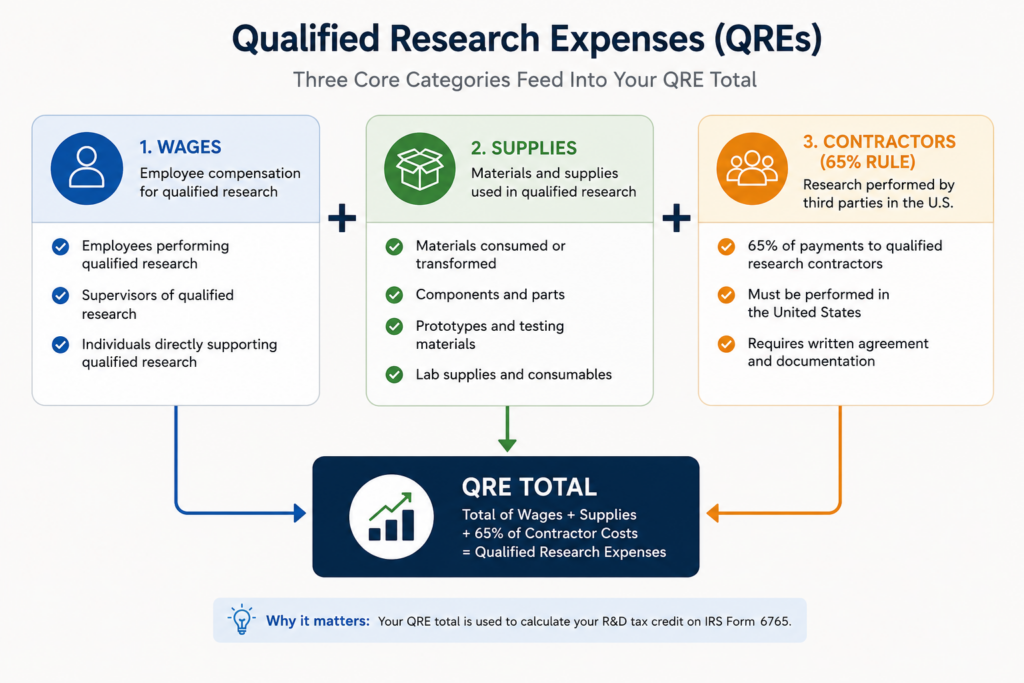
The credit is calculated as a percentage of your QREs. There are two methods:
A simplified example using the ASC method:
Item | Amount |
Current year QREs | $500,000 |
Average QREs (prior 3 years) | $300,000 |
50% of average QREs | $150,000 |
Excess QREs ($500K – $150K) | $350,000 |
ASC credit (14% × $350,000) | $49,000 |
A $49,000 credit dollar-for-dollar against your tax bill from $500K in qualifying wages. And that’s a relatively modest QRE base. Companies with larger R&D payrolls see proportionally larger credits.
Absolutely and this is one of the most common qualifying scenarios for small businesses today.
Any software development work that involves genuine technical uncertainty qualifies: Building new applications from scratch, designing novel SaaS platform architecture, training machine learning models, developing custom APIs, or innovating within cloud infrastructure. The IRS has explicitly confirmed software development as a qualifying activity under Revenue Procedure 2000-50.
The documentation advantage for software companies is real: your Git commit histories, sprint logs, JIRA tickets, and architecture documents are timestamped records of your experimentation process exactly what the IRS wants to see.
Yes, within the IRS statute of limitations, which is typically three years from the original filing date (or two years from when the tax was paid, whichever is later). This means if your business has been doing qualifying R&D for the past several years without claiming the credit, you may be able to file amended returns and recover those credits retroactively.
For small businesses with multi-year R&D histories, lookback studies can generate substantial one-time recoveries. Not uncommon to see $100,000-$500,000 in cumulative credits from a three-year lookback on a mid-sized engineering or software firm.
The core form is IRS Form 6765 Credit for Increasing Research Activities. It’s filed with your annual business income tax return (Form 1120 for C-corps, Form 1065 for partnerships, Form 1120-S for S-corps).
Your CPA is essential. But unless they specialize in R&D credits, they’re probably not set up to conduct the technical study, interview your engineering team, document qualifying activities, and produce the IRS-ready substantiation file that maximizes and defends your claim.
An R&D tax credit consulting service specializes in exactly this work. They know which activities qualify, how to allocate time defensibly, and what documentation survives audit scrutiny. Most work on contingency no credit found, no fee which means the engagement is effectively self-funding.
For most small businesses claiming more than $20,000 in credits, the consultant’s expertise pays for itself many times over.
Here’s the simple truth: if your small business is doing technically challenging work improving products, developing software, engineering new processes, experimenting with materials you are almost certainly generating tax credits you’re not claiming.
The Small Business R&D Tax Credit is one of the most accessible federal incentives available. It rewards innovation at every stage, from pre-revenue startups to established manufacturers. It reduces your income tax bill, or your payroll taxes, or both. And it’s available for the last three years of returns you may have already filed.
The opportunity is there. The key is identifying the right activities, calculating the credit correctly, and supporting your claim with the documentation the IRS expects.
TaxDrone.AI helps small businesses identify qualifying research, organize the documentation behind every claim, and uncover credits that often go unclaimed.
See TaxDrone.AI in action and find out what your business may be missing.

