How the R&D Tax Credit Works for S Corps, LLCs and Partnerships
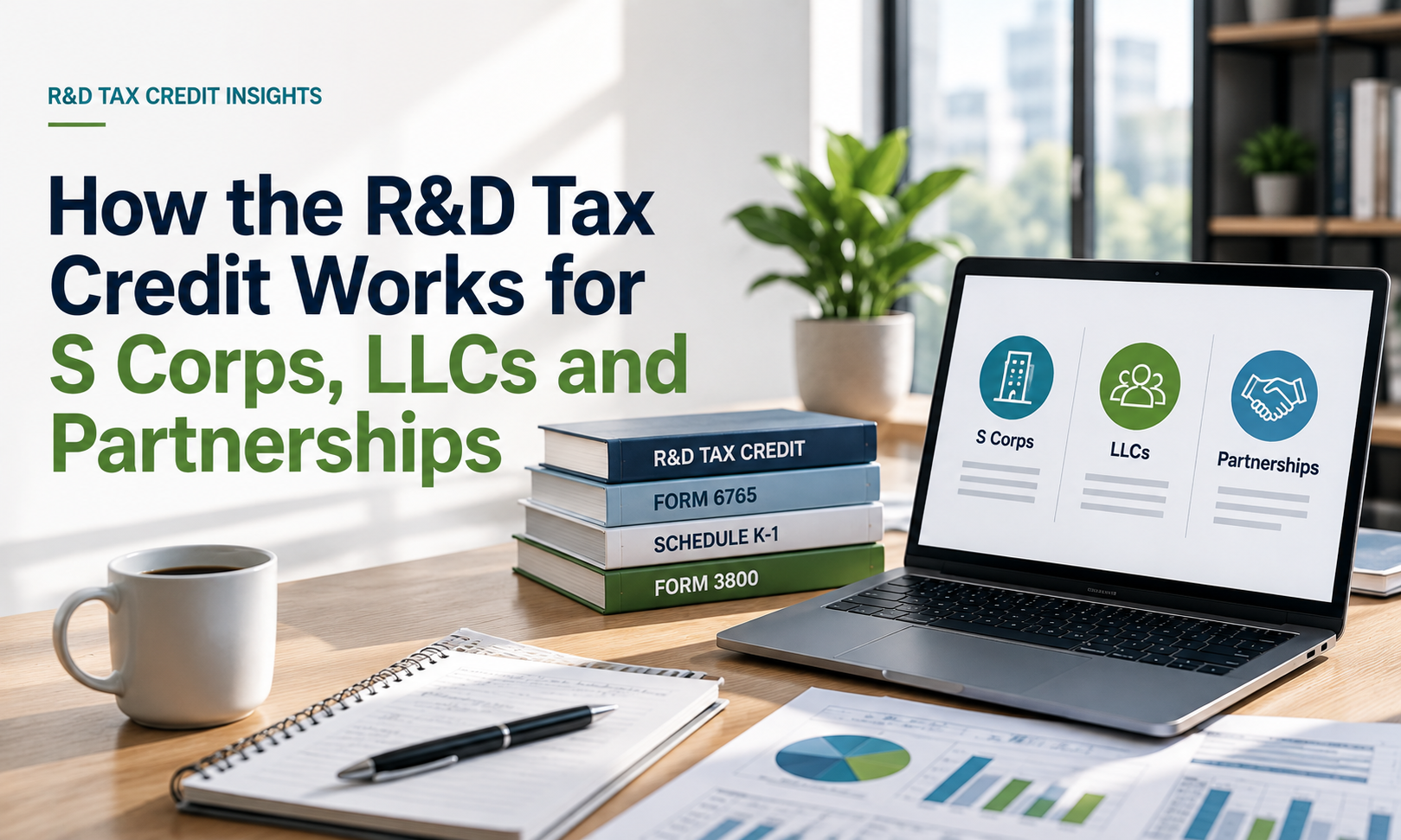
Quick answer: S corporations, partnerships and multi-member LLCs taxed as partnerships calculate the R&D tax credit at the entity level on Form 6765, then pass it through to owners on Schedule K-1. Owners claim their share on their personal returns through Form 3800, where limits like the general business credit limitation and passive activity rules apply. Certain eligible small businesses may use the research credit against alternative minimum tax, subject to the requirements and limitations that apply to the credit.
Most small and mid-size companies in the U.S. are organized as pass-through entities. That means the R&D tax credit doesn’t stop at the business. It flows to the owners, who use it on their own tax returns.
This creates opportunities, but also some traps. Here’s how the credit works when your business is an S corporation, LLC or partnership.
Step 1: The Entity Calculates the Credit
The business identifies qualified research activities, calculates qualified research expenses (QREs), and computes the credit on Form 6765. The calculation is the same as for a C corporation, using either the regular method or the Alternative Simplified Credit.
Learn more about calculating the credit on our R&D tax credits page.
Step 2: The Credit Passes to Owners
The credit is allocated to owners on Schedule K-1:
- S corporations allocate by ownership percentage.
- Partnerships and LLCs allocate according to the partnership agreement, generally following how the related expenses are allocated.
A single-member LLC that is disregarded for tax purposes reports the credit directly on the owner’s return.
Step 3: Owners Claim the Credit
Each owner claims their share on Form 3800, General Business Credit, attached to their personal return. The credit reduces federal income tax dollar for dollar, subject to several limits.
Limits That Apply at the Owner Level
General Business Credit Limitation
The R&D credit is part of the general business credit, which can’t reduce tax below certain thresholds tied to tentative minimum tax. Unused credits can generally be carried back one year and forward up to 20 years.
Alternative Minimum Tax Relief for Eligible Small Businesses
Since the PATH Act of 2015, eligible small businesses can use the R&D credit to offset alternative minimum tax. For this purpose, an eligible small business generally has average annual gross receipts of $50 million or less for the prior three years. For pass-through entities, the test applies at both the entity and owner level. This rule makes the credit far more usable for many owners.
Passive Activity Rules
Owners who don’t materially participate in the business may be treated as passive investors. In that case, the R&D credit may only offset tax on passive income. Unused passive credits carry forward until the owner has passive income or disposes of the interest.
The Section 280C Choice for Pass-Throughs
Since the One Big Beautiful Bill Act, businesses must either reduce their domestic research deduction under Section 174A by the credit amount or elect a reduced credit under Section 280C. The reduced credit is calculated using the 21% corporate rate, even for pass-through entities. Because owners may pay tax at individual rates up to 37%, keeping the full deduction and electing the reduced credit can be more valuable for many pass-through owners. The election is made on a timely filed original return.
Startups: The Payroll Tax Offset
Pass-through startups can benefit from the payroll tax election. A qualified small business, with gross receipts under $5 million and no gross receipts before the five-year period ending with the current year, can elect to apply up to $500,000 of credit per year against employer payroll taxes.
For pass-throughs, this election is made at the entity level on Form 6765. The credit then offsets the company’s payroll taxes rather than flowing to owners. That’s often ideal for early-stage companies whose owners have little income to offset. Read more in your startup is unprofitable, you still qualify for up to $500K in R&D credits.
An Example
An engineering firm organized as an S corporation has two equal owners. It calculates a $120,000 federal R&D credit.
- Each owner receives $60,000 on their K-1.
- Both owners materially participate, so passive limits don’t apply.
- The firm qualifies as an eligible small business, so the credit can offset AMT.
- Each owner uses the credit to reduce federal income tax, carrying forward anything that can’t be used this year.
Figures are illustrative. Individual results depend on each owner’s full tax picture.
Controlled Groups and Multiple Entities
If owners control several related businesses, the companies may need to be treated as a single taxpayer for credit calculations. Gross receipts and QREs are aggregated across the controlled group, and the credit is then allocated among members. This affects eligibility for small business benefits too.
State Considerations
Many states offer their own R&D credits, and states treat pass-throughs differently. Some allow credits to flow to owners, while others apply them at the entity level. Some states also offer refundable credits. See our states served page for more.
Common Mistakes
- Not coordinating with owners’ tax preparers. Owners need K-1 details to claim the credit.
- Ignoring passive activity limits. Passive owners may not be able to use the credit right away.
- Missing the payroll election deadline. It must be made on a timely filed original return.
- Overlooking the 280C choice. The right answer often differs for pass-throughs.
- Forgetting controlled group rules. Related entities may need to be combined.
Planning Tips for Owners
Talk with your CPA before year-end about expected QREs, each owner’s income and participation, and whether the payroll election or the 280C election makes sense. Coordinating these choices early helps owners actually use the credit instead of carrying it forward for years.
Owner Communication Checklist
Because the credit ends up on owners’ returns, communication is key. Before K-1s go out, make sure each owner knows:
- The amount of credit allocated to them
- Whether the business qualifies as an eligible small business
- Whether they materially participate in the business
- Whether the entity made the payroll tax or 280C elections
- Any state credits that also flow through
A short memo with this information helps each owner’s tax preparer use the credit correctly.
The Bottom Line
The R&D credit can be just as valuable for pass-through owners as for C corporations, but only if it’s planned with the owners in mind. Participation, income levels, elections and state rules all shape how much of the credit owners can actually use each year.
Key Takeaways
- Pass-throughs calculate the credit on Form 6765 and pass it to owners on K-1s.
- Owners claim the credit on Form 3800, subject to general business credit limits.
- Eligible small businesses can use the credit against AMT.
- Startups can elect the payroll tax offset at the entity level.
Frequently Asked Questions
Can an S corporation claim the R&D tax credit?
Yes. The S corporation calculates the credit on Form 6765 and passes it to shareholders on Schedule K-1, who claim it on their personal returns.
How do LLC owners claim the R&D tax credit?
LLCs taxed as partnerships allocate the credit on Schedule K-1. Owners claim their share on Form 3800 with their personal returns.
Can pass-through owners use the R&D credit against AMT?
Yes, if the business and owner qualify as an eligible small business, generally with average annual gross receipts of $50 million or less.
Do passive owners benefit from the R&D credit?
Passive owners can generally only use the credit against tax on passive income, with unused amounts carried forward.
Can a pass-through startup use the payroll tax offset?
Yes. A qualified small business organized as a pass-through can elect at the entity level to apply up to $500,000 of credit against payroll taxes.
Own an S corp, LLC or partnership? Get a free estimate from TaxDrone.AI.
This article is general information and not tax advice. Consult a qualified tax professional about your situation.