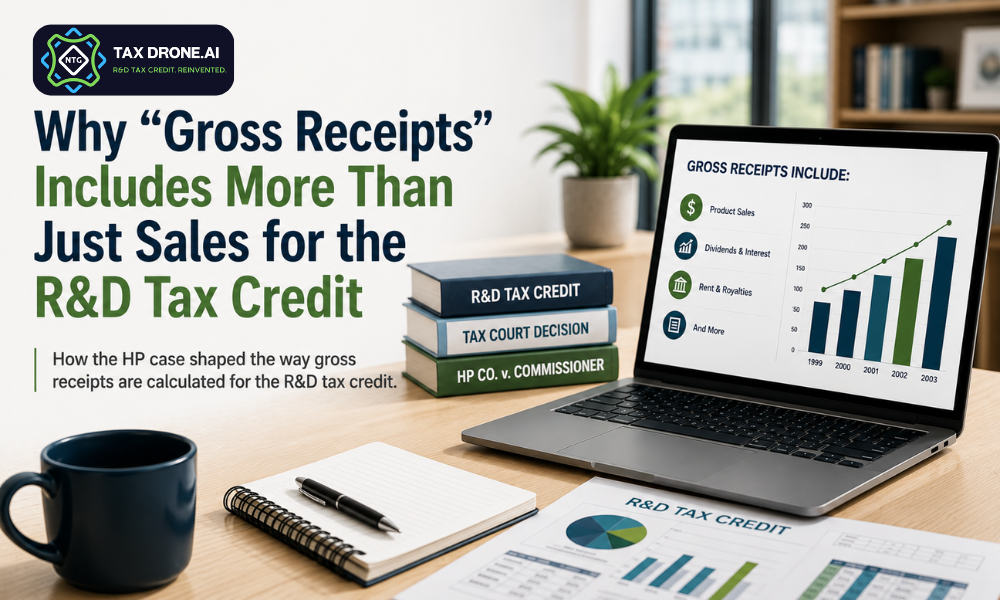
If your company earns income beyond product sales, dividends, interest, rent, or licensing royalties, does that income count against your R&D tax credit? Most businesses assume the credit calculation only looks at sales. The U.S. Tax Court addressed that question in a case involving Hewlett-Packard, and the answer surprised a lot of tax advisors at the time.
For tax years 1999 through 2003, HP calculated its research credit using a method called the Alternative Incremental Research Credit, or AIRC. That method required HP to figure out its average annual gross receipts for the four years before each credit year, a number that fed directly into how large the credit could be. A bigger gross receipts figure generally means a bigger base amount, which means a smaller credit.
HP and the IRS disagreed over two separate questions about what belonged in that gross receipts number:
Both sides asked the Tax Court to decide the issues on summary judgment, without a full trial, since neither side disputed the underlying facts.
HP won the first fight, though not because the court ruled in its favor on the merits. The IRS simply conceded the point on intercompany CFC revenue, so the court granted HP’s motion on that issue without much analysis. It’s a useful procedural point, but not a legal precedent on the merits because the IRS conceded the issue.
The second fight is where the real substance lives, and HP lost it. The company argued that “gross receipts” should mean sales income only, pointing to a dictionary definition and to the fact that the statute excludes “returns and allowances,” a phrase HP said only makes sense in a sales context. The court wasn’t persuaded. A few reasons stood out:
The court also looked at a nearly identical “gross receipts” definition used elsewhere in the tax code, for accounting method rules under section 448, which explicitly includes interest, dividends, rents, and royalties regardless of whether they come from a company’s core business. That parallel language mattered.
Here’s where historical context matters. The specific credit method at issue in this case, the AIRC, no longer exists. Congress repealed it for tax years beginning after December 31, 2008. So HP’s exact fact pattern can’t recur today.
That doesn’t make the case irrelevant, though. Companies today can still elect the traditional Regular Credit method, which calculates a base amount using a fixed-base percentage multiplied by average gross receipts over the prior four years, the same basic mechanic at the center of this case. For those companies, the broad definition of gross receipts that HP lost on still applies.
It’s a different story for companies using the Alternative Simplified Credit, the method most businesses use today. The ASC formula compares current year research expenses to a percentage of the prior three years’ research expenses. Gross receipts don’t enter into the calculation at all. For companies on the ASC method, this particular fight simply doesn’t come up.
Most of the attention in R&D credit conversations goes to whether specific projects qualify. This case is a reminder that the math behind the credit matters just as much, and gets far less attention. Getting the formula inputs wrong, whether that’s gross receipts, the fixed-base percentage, or the choice between the Regular Credit and the ASC, can shrink a credit even when every dollar of underlying research expense is legitimate.
TaxDrone.AI, built by National Tax Group (NTG), models both calculation methods and helps businesses see which one actually produces the better result for their situation, rather than defaulting to whichever method was used last year without checking.
Qualifying research is only half the equation. The way your credit is calculated determines how much of that qualifying work actually turns into a dollar benefit.
Get your free R&D tax credit estimate and see whether your current method is giving you the credit you’re actually entitled to.