
TG Missouri: When Physical Possession Did Not Decide the R&D Tax Credit
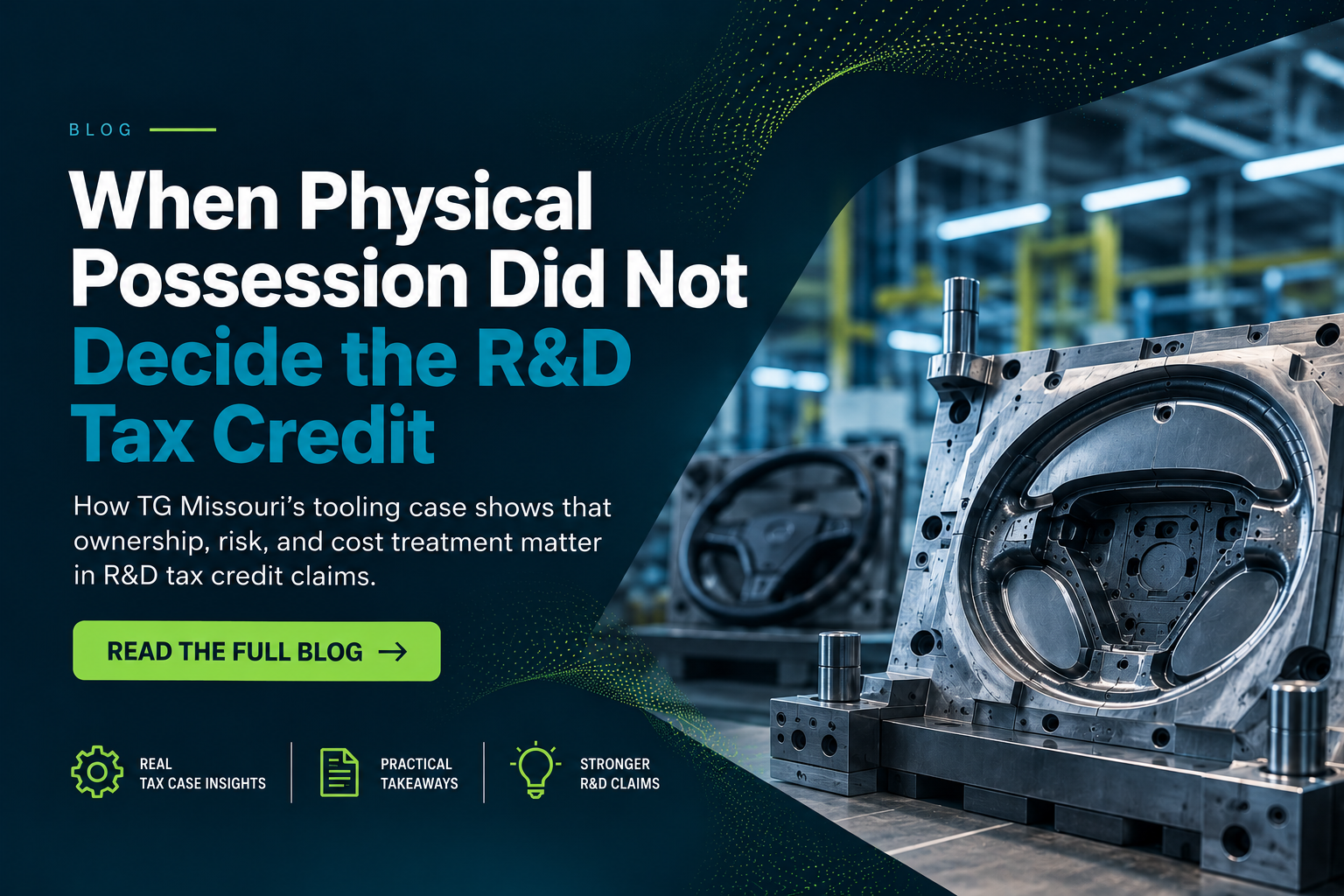
TG Missouri Corporation made steering wheels, air bags, and body side molding for automotive customers. To do it, the company designed and modified production molds, then used them to mass-produce parts. Some molds it kept. Others it sold to the customer while continuing to hold and use them on the shop floor.
The IRS looked at that second group and disallowed the research credit tied to them. Its argument: these molds were tangible property with a useful life over a year, the kind of asset ordinarily subject to depreciation, so they couldn’t count as “supplies” under Section 41. TG Missouri disagreed, and the case went to Tax Court.
The IRS Challenged the Cost Treatment, Not the Engineering Work
TG Missouri manufactured automotive components and developed production molds to meet customer specifications. Its engineers modified and tested the molds before they were used in production.
Depending on the agreement, TG Missouri either:
- Retained ownership of the completed mold and depreciated its cost, or
- Sold the mold to the customer while continuing to use it for production.
For the molds it sold, TG Missouri treated the third-party toolmaker costs as qualified research expenses under Section 41.
The IRS challenged that treatment. Its position was that the molds were tangible property with a useful life of more than one year and therefore fell within the depreciation exclusion from “supplies” under Section 41.
The Court's Test: Who Bears the Risk, Not Who Holds the Keys
The Tax Court sided with TG Missouri. It held that “property of a character subject to the allowance for depreciation,” the phrase both Section 41(b)(2)(C) and Section 174(c) use to exclude certain property from supply expense treatment, means property depreciable in the hands of that specific taxpayer, not property that is generically the type of thing someone, somewhere, could depreciate.
The court’s reasoning centered on economic ownership: generally, only a taxpayer with an economic interest in an asset can deduct depreciation on it. Once a mold was sold, the customer bore the risk of loss from wear and deterioration, even while TG Missouri kept physical custody. That made the difference.
The Bigger R&D Credit Lesson Is in the Supporting Facts
The case illustrates why an R&D tax credit claim cannot be evaluated only by looking at what engineers did.
A company may have legitimate technical research, but the treatment of the related costs can raise a separate question.
For manufacturers, that can require looking at:
- Customer contracts and ownership terms
- When title transferred
- Who bore the risk of loss
- How the property was treated for tax purposes
- What costs were included in the R&D claim
- Documentation connecting the costs to the qualifying research
Physical possession alone did not answer those questions in TG Missouri.
Why This Still Matters for 2026 R&D Claims
The tax treatment of domestic research expenditures has changed since the years involved in TG Missouri. Section 174A generally permits taxpayers to deduct qualifying domestic research or experimental expenditures for tax years beginning after December 31, 2024, subject to the rules and elections under that provision.
That change should not be confused with the separate question of whether an expenditure qualifies for the Section 41 R&D tax credit.
For manufacturers, the practical issue remains: the engineering activity, the cost, and the facts supporting the tax treatment need to line up.
A Defensible Claim Starts With More Than the Project Description
The TG Missouri decision is a useful example of why R&D credit documentation should capture more than a description of the technical work.
For customer-specific tooling and similar projects, the underlying agreements and ownership facts may become important when determining how costs should be treated.
That information is much easier to establish while the project and contract records are current than years later during an examination.
How TaxDrone.AI Can Help
TaxDrone.AI evaluates R&D activity at the project level against the requirements of Section 41.
For manufacturers, that means the analysis can go beyond identifying technical work. Relevant project documentation and cost information can also be considered when determining whether the facts support the position being taken on an R&D claim.
Want to Know If Your Tooling or Prototype Costs Would Hold Up?
If your company develops customer-specific tooling, prototypes, or other products as part of its R&D activities, make sure the technical work and the supporting cost records tell the same story.
Get your free R&D tax credit estimate and see whether your current approach is capturing the credit your qualifying R&D may support.
Latest Blogs

How the R&D Tax Credit Works for S Corps, LLCs and Partnerships

