
Form 6765 Instructions for 2026: What R&D Tax Credit Claimants Must Document
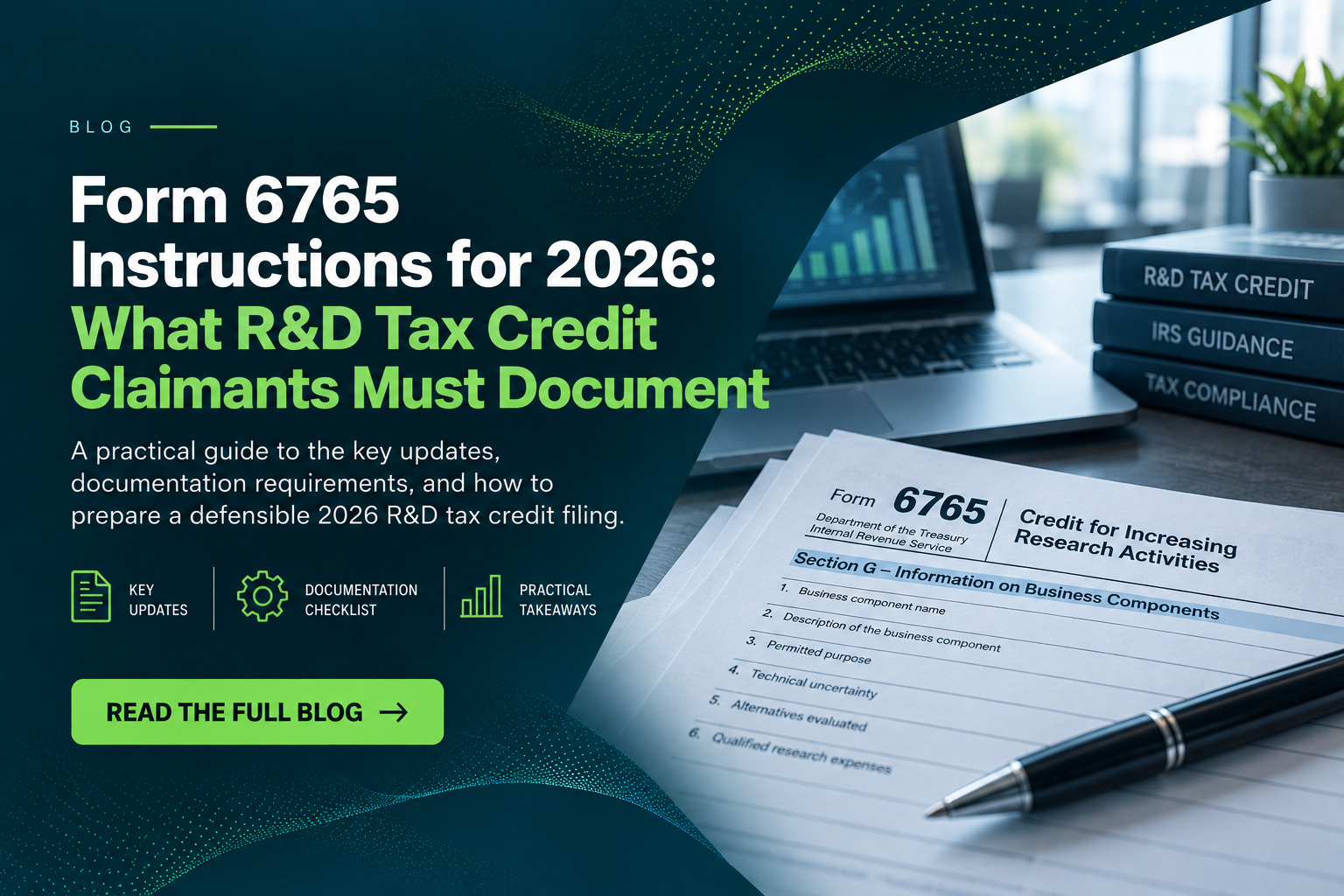
Form 6765 is the federal form used to calculate and claim the credit for increasing research activities, elect the reduced credit under Section 280C and, when eligible, elect the research credit against payroll taxes. For tax years beginning after 2025, Section G of Form 6765 generally becomes required, subject to specific rules and exceptions. That makes business-component information more important for many 2026 filings.
A defensible filing starts before tax preparation. Businesses should identify the products, processes, software programs, techniques, formulas or inventions included in the claim, connect the research to the four-part test and map qualified wages, supplies and contract research expenses to the underlying activities.
Why Form 6765 requires earlier preparation
The R&D tax credit is not supported by a single annual total. Eligibility is evaluated through the work performed on specific business components. That makes the form the final output of a yearlong evidence process, not a substitute for one.
Businesses that wait until the return is nearly due often discover that their general ledger shows who was paid but not what technical uncertainty each person addressed. Project-management systems may show tasks without explaining alternatives considered. Engineering files may contain test results but no clear connection to wage allocations. These records are useful, yet they become much stronger when organized around the same business components and activities reported on the return.
The current TaxDrone.AI research-credit workflow is designed around this component-level analysis. It helps turn operational records into a structured account of the research, the people involved and the qualified expenses claimed.
What Form 6765 is used for
Form 6765 supports several related federal elections and calculations. Depending on the taxpayer, it may be used to calculate the regular research credit or the alternative simplified credit, make a reduced-credit election under Section 280C, report amounts allocated among members of a controlled group, and elect a qualified small-business payroll-tax credit.
The correct calculation method depends on historical qualified research expenses and gross receipts, available records, prior elections and the taxpayer’s broader tax position. The larger credit is not automatically the better answer if the underlying data cannot support it. Calculation should follow eligibility analysis, not drive it.
What Changes for Form 6765 in 2026?
One of the most important changes for tax years beginning after 2025 is the treatment of Section G.
For tax years beginning before 2026, Section G is optional for all filers, subject to the separate rules for amended returns. For tax years beginning after 2025, Section G is generally required, subject to the applicable guidelines and exceptions in the IRS instructions.
That means businesses filing for a 2026 tax year should not assume that a high-level annual summary of research expenses will be enough. The IRS instructions require taxpayers subject to Section G to report business-component information and reconcile those amounts with the qualified research expense information reported elsewhere on Form 6765.
The exact filing requirement can depend on the taxpayer’s circumstances, so businesses should review the current instructions rather than assume Section G applies identically to every taxpayer.
Understanding Section G and business components
Section G is intended to capture information about business components included in the claim. A business component can be a product, process, computer software, technique, formula or invention that the taxpayer holds for sale, lease or license or uses in its trade or business.
For each reported component, the company should be able to explain the permitted purpose, the technical uncertainty that existed, the alternatives evaluated and the technological principles used. The description should be specific enough to distinguish one project from another. “Software development” or “product improvement” is usually too broad to explain what was actually investigated.
A useful component name identifies the deliverable or technical objective, such as “automated invoice-matching engine,” “high-temperature pump seal” or “reduced-sugar shelf-stable beverage formula.” The project narrative should then show how experimentation addressed uncertainty about capability, method or appropriate design.
The four-part test behind the form
Every claimed research activity must satisfy the statutory requirements. In practical terms, the analysis asks four questions.
1. Was there a permitted purpose?
The work must seek to create or improve functionality, performance, reliability or quality of a business component. Changes aimed only at style, taste, cosmetic appearance or seasonal design generally require careful exclusion analysis.
2. Was technical uncertainty present?
At the outset, the team must be uncertain about whether the objective was technically achievable, how it could be achieved or what design would be appropriate. Market uncertainty, schedule pressure and ordinary cost concerns do not establish this element by themselves.
3. Was there a process of experimentation?
Substantially all of the research activities must form a process designed to evaluate alternatives. Modeling, simulation, systematic trial and error, prototyping, testing and iterative engineering may provide evidence. Routine debugging or validation of a known method does not automatically qualify.
4. Was the work technological in nature?
The experimentation must fundamentally rely on principles of physical or biological science, engineering or computer science. The records should show the technical discipline applied rather than merely labeling the project innovative.
Qualified research expenses reported on Form 6765
The federal credit generally considers three principal cost categories.
1. Employee wages
Wages may qualify to the extent employees directly perform, directly supervise or directly support qualified research. Job titles alone are insufficient. A developer, engineer or laboratory technician may split time between qualified development, routine production support, administration and maintenance. The wage allocation should reflect the activities actually performed.
2. Supplies
Supplies used or consumed in qualified research may be included, subject to the statutory rules. Prototype materials, test batches and expendable components can be relevant. Capital assets, general overhead and property subject to depreciation are not simply treated as qualified supplies.
3. Contract research
Generally, 65% of eligible amounts paid for qualified research performed on the taxpayer’s behalf in the United States may enter the federal calculation. The agreement must be evaluated for payment risk and rights in the research. An invoice labeled “engineering” does not resolve funded-research questions.
Documentation checklist for a 2026 filing
- Create a complete list of business components before calculating the credit.
- Record the technical uncertainty for each component in plain, specific language.
- Preserve alternatives, prototypes, test plans, results, failures and design revisions.
- Identify employees who performed, directly supervised or directly supported the research.
- Reconcile wage allocations to payroll records and project evidence.
- Connect supplies and contractor costs to the relevant components.
- Review contracts for funded-research terms, intellectual-property rights and acceptance risk.
- Reconcile Section G information to the credit calculation and tax-return workpapers.
- Retain source records and document the methodology used for estimates or sampling.
- Complete an independent technical and tax review before filing.
Common Form 6765 mistakes
One common mistake is starting with employee percentages and trying to create project narratives afterward. Another is grouping unrelated work into a generic component. Businesses also overinclude routine maintenance, production, quality control after uncertainty has been resolved, customer support and administrative time.
Inconsistent numbers create another risk. The component-level costs, calculation schedules, payroll files and return must tell the same story. If the filing reports a large wage amount but the project record names only a few participants, the disconnect deserves resolution before submission.
Statistical sampling may reduce the burden for large populations, but it does not remove the need to establish qualification at the proper unit of analysis. Companies considering this approach should review TaxDrone.AI’s statistical-sampling process before selecting a sample design.
How TaxDrone.AI can help
TaxDrone.AI organizes business components, technical activities, personnel and expenses in a consistent workflow. That structure helps companies capture contemporaneous support, apply qualification rules systematically and produce a clearer record for the return preparer.
The platform does not turn every development expense into a credit. Its value is disciplined separation: qualified research from nonqualified work, supported allocations from guesses and component-level evidence from generic annual narratives.
A 90-day readiness plan for finance and technical teams
During the first 30 days, finance should export payroll, contractor and general-ledger detail while technical leaders create the initial business-component inventory. The goal is completeness, not qualification. Include successful, failed and abandoned projects so the review is not biased toward market outcomes.
During days 31 through 60, project owners should document uncertainty, alternatives, tests and resolution dates. Finance can map employees and expenses to the same component identifiers. Any mismatch such as a large contractor invoice with no corresponding technical record—should be investigated while participants can still explain it.
During days 61 through 90, the tax team applies exclusions, chooses the calculation method, evaluates Section 280C and prepares the component-level return support. A reviewer independent of the initial analysis should test whether narratives are specific, allocations reconcile and the evidence supports the conclusions.
This schedule turns Form 6765 preparation into a controlled close process. It also creates reusable structure for the following year instead of rebuilding the claim from memory.
Assign one owner to maintain the component list and one technical contact for each project. Clear ownership keeps names, dates and expense mappings consistent when personnel change or projects span multiple tax years.
Frequently asked questions
1. Is Section G required for every taxpayer?
Requirements and exceptions depend on the applicable form instructions, taxpayer size and filing situation. Review the instructions for the exact return year rather than relying on an earlier form.
2. Does completing Form 6765 prove the activities qualify?
No. The form reports the claim; underlying records must substantiate that the activities and expenses meet Section 41.
3. Can project-management records support the credit?
Yes. Tickets, sprint records, test reports and design files can be valuable when they identify the component, uncertainty, alternatives, participants and dates.
4. Should a business use the regular credit or alternative simplified credit?
The answer depends on available historical data and the taxpayer’s facts. Model both methods when appropriate, then confirm that the selected method is supportable.
What should a company do first?
Start by inventorying active and completed development projects and identifying potential business components.
Then connect those components to the technical activities, employees and expenses supporting the claim.
Businesses preparing for a 2026 filing can also request a TaxDrone.AI R&D credit assessment before the filing deadline creates avoidable pressure.
Latest Blogs

How the R&D Tax Credit Works for S Corps, LLCs and Partnerships

