Let’s be real for a second. Running a startup is an exercise in managing burn. Every payroll run, every quarterly tax deposit, every employer-side Social Security payment chips away at the runway you’ve worked so hard to build. You’re paying engineers, scientists, developers people doing genuinely innovative work and then writing checks to the IRS on top of it.
Here’s what most early-stage founders don’t know: the federal government has a mechanism specifically designed to give some of that money back. Not someday, when you’re profitable and have income tax liability. Now. As a direct reduction against the payroll taxes you’re already writing checks for.
It’s called the Payroll Tax Offset R&D Credit, and it’s one of the most underutilized startup tax incentives in the entire U.S. tax code.
This guide is the one I wish every pre-revenue founder had on day one.
The Payroll Tax Offset is a provision added to the federal R&D tax credit (Section 41 of the Internal Revenue Code) through the PATH Act of 2015, and significantly expanded by the Inflation Reduction Act of 2022. It allows qualified small businesses to apply a portion of their R&D tax credit directly against their employer payroll tax liability specifically, the employer’s share of Social Security taxes.
Why does this matter? Because most startups don’t have income tax liability. Traditional R&D credits reduce your income tax bill, which is great but if you’re pre-revenue or operating at a loss, that credit just sits as a carryforward. Useful eventually. Not useful now.
The payroll tax offset flips that. It converts your R&D credit into immediate cash flow, reducing what you owe with every payroll deposit.
To be a qualified small business eligible for the payroll tax offset, your company must meet both of the following:
This is deliberately designed for early-stage companies. Startups, seed-funded ventures, pre-revenue innovators. If you’re a bootstrapped SaaS company or an AI startup burning cash on R&D salaries, this is written for you.
Requirement | Detail |
Gross receipts threshold | Less than $5 million in the election year |
Business age | No revenues prior to the 5-year lookback window |
Entity type | C-corps, S-corps, partnerships, LLCs all eligible |
Qualifying activity | Must have qualified research expenses (QREs) under Section 41 |
Form requirement | Must elect on Form 6765 and apply via Form 941 |
One important note: the business age requirement is measured against gross receipts, not incorporation date. If your company had any revenue more than five years ago even a small amount you may not qualify. Worth verifying carefully with a consultant.
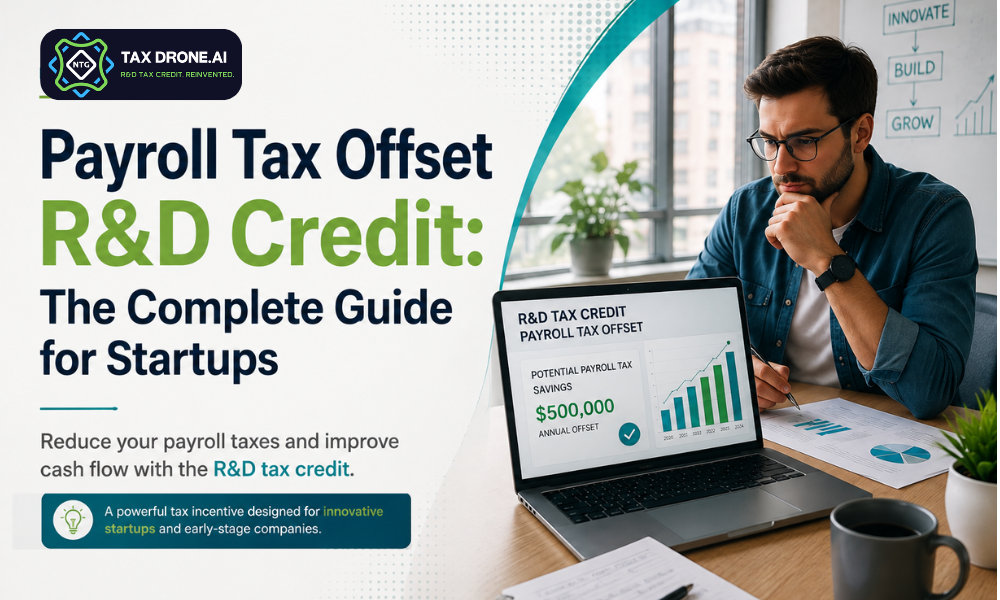
As of the Inflation Reduction Act of 2022, qualified small businesses can offset up to $500,000 per year in payroll taxes using their R&D credit. Prior to 2023, the limit was $250,000 annually. That doubling was a big deal and a lot of startups still don’t know it happened.
The offset applies against the employer’s share of Social Security taxes (6.2% of wages up to the annual wage base). It does not apply to Medicare taxes.
So if your company has a $400,000 R&D credit and elects the payroll tax offset, you can reduce your quarterly Social Security tax deposits by up to $400,000 across the year (up to the $500K cap). That’s real cash staying in your operating account instead of going to the IRS.
Here’s the practical flow from R&D activity to reduced payroll deposit:
Step 1: Conduct an R&D Tax Credit Study Identify your qualified research expenses (wages, supplies, contractor costs) and calculate your Section 41 credit using either the Regular Credit or Alternative Simplified Credit (ASC) method.
Step 2: Make the Election on Form 6765 On your annual income tax return, complete IRS Form 6765 (Credit for Increasing Research Activities) and elect to apply the credit against payroll taxes. This election must be made by the due date of the return, including extensions.
Step 3: Apply the Credit via Form 941 The elected credit is applied in the first calendar quarter beginning after the election is made. You’ll reflect the offset on Form 941 (Employer’s Quarterly Federal Tax Return), reducing your Social Security tax deposits accordingly.
Step 4 Repeat Annually The election is made year by year you’re not locked in. Each year you evaluate your qualifying activity and elect the offset if it makes sense.
Form | Purpose |
Form 6765 | Calculate R&D credit and make payroll tax offset election |
Form 941 | Apply the elected credit against quarterly payroll taxes |
Form 3800 (in some cases) | General Business Credit may be needed depending on entity type |
The Form 6765 election is where most mistakes happen. The election must be affirmatively made it’s not automatic. And once the tax return is filed, amending to add or change the election can be complicated. Get this right the first time.
The QRE calculation for the payroll tax offset is identical to the standard R&D credit three categories:
Yes and this is exactly why the offset exists. The entire point of the payroll tax election is to provide a benefit to companies that can’t use the traditional income tax credit because they’re not yet profitable.
Loss-stage startup? You qualify to make the election. Zero income tax liability? Doesn’t matter. The offset goes against payroll taxes, not income taxes. These are two separate pots of money and the offset taps the payroll pot directly.
This is what makes the startup R&D tax credit via the payroll offset so powerful for early-stage companies: it generates value right now, not in some hypothetical profitable future year.
This is a nuanced one. You can file amended returns to claim R&D credits for prior open tax years and elect the payroll tax offset but there are rules around timing and the election mechanics. Generally, the IRS allows amendments within the statute of limitations (three years from the original filing date).
However, the payroll tax offset is applied prospectively once elected meaning the credit reduces future payroll deposits, not past ones. So retroactive credit recovery is possible, but you can’t go back and un-pay prior payroll taxes. You apply the recovered credit going forward.
This is an area where working with an R&D payroll tax credit consultant is particularly valuable, because the amended return process has procedural requirements that, if missed, can complicate or disallow the retroactive claim.
The documentation requirements for the payroll offset are the same as for any R&D tax credit claim because the offset is derived from the same underlying credit calculation. You need:
The key word, as always, is contemporaneous. Records created during the research activity are significantly stronger than reconstructed documentation.
The payroll tax offset is industry-agnostic what matters is the nature of the work, not the sector. That said, certain industries generate qualifying activity almost by default:
If your startup is building something genuinely technical something where the outcome isn’t certain until you’ve experimented your way to it you’re in qualifying territory.
For most startups, the honest answer is yes and I’ll tell you exactly why.
The payroll tax offset is mechanically straightforward once it’s set up. But getting there requires: a defensible QRE calculation, a correctly filed Form 6765 election, proper Form 941 application, and documentation that holds up if the IRS ever asks questions. Each of those steps has pitfalls.
Most startup founders and even most CPAs are not deeply familiar with the technical requirements of R&D credit studies. A startup R&D tax credit consultant who specializes in this area will:
Most work on a contingency fee basis so if they don’t find credits, you don’t pay. If they do, the economics almost always favor engagement.
Here’s what I want you to take away from this.
Your startup is doing real, innovative, technically uncertain work. Your engineering team, your scientists, your developers they’re generating qualified research expenses with every hour they work. And the federal government has carved out a specific mechanism to give some of that money back, even before you’re profitable.
The Payroll Tax Offset R&D Credit is that mechanism. Up to $500,000 per year. Applied directly against Social Security tax deposits. Available to qualified small businesses doing qualifying research.
If you’re an early-stage company and you’re not claiming this, you’re funding the IRS instead of your product roadmap.
Find out what your startup qualifies for. A quick eligibility assessment with an R&D tax credit specialist takes less time than your next sprint planning session and the return is a lot more tangible.